Quick answer: no, but it will change the model
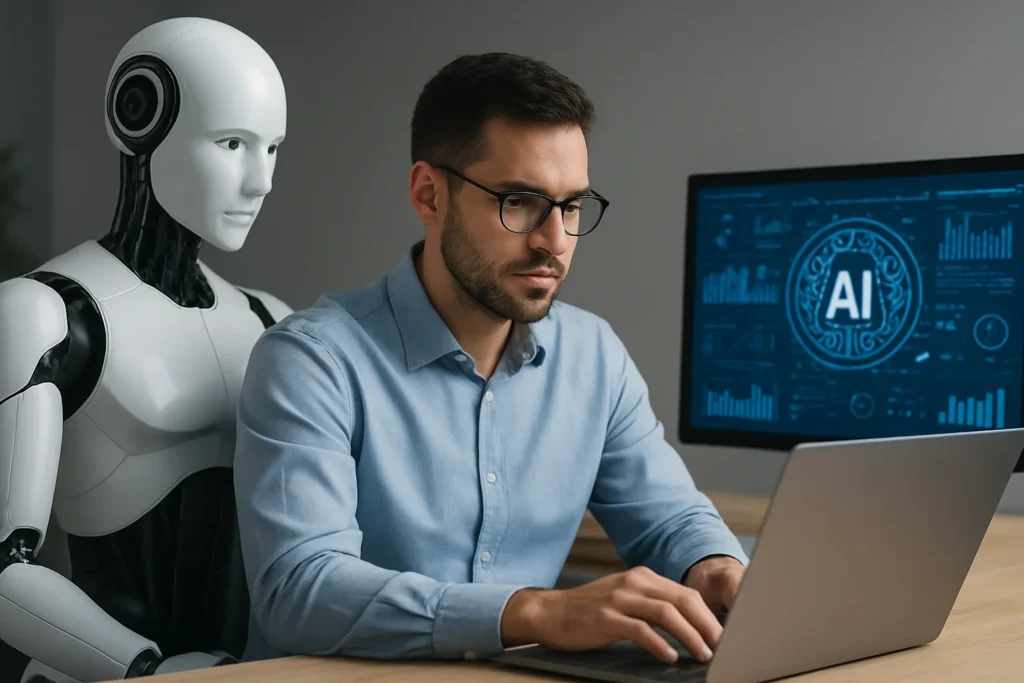
The real question is not whether AI will kill IT outsourcing. The real question is which parts of outsourcing will become cheaper, faster, and more automated, and which parts will still require human judgment, delivery discipline, and accountability.
AI can accelerate coding, testing, documentation, and support tasks. It cannot replace product understanding, architecture decisions, security ownership, stakeholder alignment, or the ability to deliver software that actually fits a business model. That is why outsourcing is not disappearing. It is becoming more selective.
For European companies, the winning model will be a mix of AI-assisted delivery and experienced teams that know how to use it safely. In other words: less manual effort, more leverage, but still no magic wand.
What does AI actually change in software outsourcing?
AI changes delivery speed, not business responsibility. A developer can now generate boilerplate code faster, summarize tickets, draft tests, and speed up refactoring. That means some tasks that used to consume hours now take minutes.
But faster code generation does not automatically mean better software. If requirements are unclear, the output is still unclear. If the architecture is weak, AI can produce more weak code, only faster. That is why AI improves productivity most when the delivery team already has strong engineering standards.
This is especially relevant for business application development Tunisia, automation development Tunisia operations, and saas maintenance outsourcing tunisia, where speed matters but maintainability matters even more. A company can use AI to move faster, but it still needs a team that knows what should be built, what should not, and what should be rewritten before it becomes technical debt with a user interface.
AI reduces effort, not ownership
A cheap developer can become very expensive when every feature needs cleanup, security review, and three rounds of clarification. AI does not remove that risk. It can even amplify it if teams ship code without review or governance.
That is why outsourcing providers that combine AI tools with senior engineering practices will become more valuable, not less. The competitive advantage shifts from “who can type code fastest” to “who can deliver reliably with the right controls.”
What still needs humans in software delivery?
AI can assist delivery, but it cannot replace the parts of software work that depend on context and accountability. These are the areas where experienced teams still matter most:
- Product discovery and scope definition
- Architecture and scalability decisions
- Security, compliance, and IP protection
- Integration with existing systems
- Code review and quality assurance
- Maintenance, support, and incident response
- Stakeholder communication and roadmap trade-offs
The business problem is simple: software is not just code. It is a system of decisions. AI can accelerate execution, but someone still has to decide what is worth building, how it will be maintained, and how it supports the company’s priorities.
That is why companies looking for nearshore software development commerce or a nearshore development team logistics setup should not ask, “Can AI do this?” They should ask, “Can this delivery model reduce cost without reducing control?” Those are very different questions.
Outsourcing without governance is not a delivery model. It is hope with a contract attached.
Which outsourcing model works best in an AI-driven market?
AI does not make all outsourcing models equal. It makes the strongest ones stronger. Companies that already use structured delivery, documentation, and clear ownership will benefit the most.
| Model | Best for | AI impact | Main risk |
|---|---|---|---|
| Freelancers | Small isolated tasks | Can speed up simple work | Low continuity and weak ownership |
| Traditional outsourcing | Project-based delivery | Faster execution if managed well | Quality gaps if governance is weak |
| Staff augmentation | Extending an internal team | Strong leverage with AI-assisted developers | Depends on internal leadership |
| Dedicated nearshore team | Long-term product delivery | Best balance of speed, control, and continuity | Requires clear onboarding and process |
For most European companies, the dedicated team model becomes even more attractive in an AI-heavy environment. Why? Because AI makes individual contributors faster, but it does not solve coordination. A team still needs product context, technical standards, and a stable delivery rhythm.
This is where a partner like LSK SOFT fits naturally. At LSK Soft, the objective is not simply to provide developers. The goal is to help European companies build reliable software delivery capacity through clear communication, strong technical execution and teams that integrate smoothly with their business priorities.
Why nearshore still matters
Nearshore development remains relevant because time zone alignment, bilingual communication, and cultural proximity still reduce friction. AI does not attend weekly syncs, clarify business priorities, or ask the right question when a requirement is incomplete. People do that.
For companies using engineering team Tunisia analytics or building infrastructure practical european companies, the value is not only lower cost. It is also faster collaboration, easier governance, and less delivery noise.
What is the business impact for CEOs and CTOs?
The business impact of AI is not “fewer developers.” It is “more output per developer, if the team is structured correctly.” That changes how companies think about recruitment, outsourcing, and roadmap execution.
For a SaaS company accelerating its roadmap, AI can shorten feature cycles. For a CTO struggling to recruit locally, AI can reduce pressure on the team by making external developers more productive from day one. For a company modernizing a legacy system, AI can help with documentation and refactoring, but only if senior engineers review the output.
That means the strategic question is no longer whether to outsource. It is how to outsource in a way that remains efficient in an AI-assisted environment. The companies that win will be the ones that combine automation with disciplined delivery, not the ones that simply chase the cheapest hourly rate.
In practical terms, AI can reduce delivery cost, but it can also increase the cost of mistakes if teams move too fast without controls. The savings are real only when quality, documentation, and code ownership are handled properly. Otherwise, the invoice arrives later, usually disguised as technical debt.
What mistakes should companies avoid?
The first mistake is assuming AI can replace senior engineers. It cannot. Senior engineers do not just write code. They reduce risk, challenge weak assumptions, and protect the roadmap from expensive detours.
The second mistake is buying outsourced capacity without asking how AI is used. Some providers will use AI responsibly with review, testing, and documentation. Others will use it to produce more code faster, while shifting the cleanup to the client. That is not efficiency. That is a very modern way to create future problems.
The third mistake is ignoring governance. If a provider cannot explain its review process, security standards, documentation habits, and handover practices, the company should be cautious. AI makes speed easier. It does not make accountability optional.
Before choosing a partner, decision-makers should check:
- How code is reviewed and validated
- How documentation is maintained
- How AI tools are used and controlled
- Who owns architecture decisions
- How knowledge transfer is handled
- How security and IP protection are enforced
How can LSK SOFT help?
LSK SOFT helps European companies extend delivery capacity with dedicated teams, staff augmentation services, and nearshore software development from Tunisia. The goal is not to replace internal leadership. The goal is to strengthen it with a team that can execute quickly, communicate clearly, and adapt to changing product priorities.
That matters especially when companies need to extend your development team, reduce recruitment bottlenecks, or launch a new product without building a full internal department first. It also matters when maintenance, modernization, and feature delivery must happen at the same time.
AI is part of the toolset, not the strategy. The strategy is to deliver better software, faster, with less operational friction. LSK Soft helps make that practical through strong engineering standards, bilingual collaboration, and an onboarding process designed to move quickly without losing control.
Should you fear AI or use it to improve outsourcing?
The practical answer is simple: use AI to improve outsourcing, not to replace it blindly. Companies that want reliable delivery still need architecture, governance, quality control, and people who understand business priorities.
If your company needs to move faster, reduce hiring pressure, or build a more flexible delivery model, AI should be treated as an accelerator inside a well-managed outsourcing setup. That is where the real value is created.
In other words, AI will not kill outsourcing. It will kill weak outsourcing models. The providers that survive will be the ones that combine automation with senior execution, clear communication, and long-term accountability.
FAQ
Will AI replace outsourced developers?
No. AI can speed up specific tasks, but it cannot replace ownership, architecture, communication, and delivery accountability. Companies still need experienced developers and technical leads.
Will outsourcing become cheaper because of AI?
Some tasks may cost less to deliver, but total project cost depends on quality, governance, and maintenance. Faster code is not cheaper if it creates rework later.
Is staff augmentation still relevant with AI?
Yes. In many cases it becomes even more useful. AI helps augmented developers be more productive, but the company still benefits from external expertise and flexible capacity.
What should I ask a software outsourcing partner about AI?
Ask how they use AI in coding, testing, documentation, and review. Also ask who validates output, how security is handled, and how knowledge transfer is managed.
Is nearshore outsourcing still a good option?
Yes, especially for European companies. Time zone alignment, bilingual communication, and easier collaboration remain strong advantages, even in an AI-driven workflow.
How can I reduce outsourcing risk in the AI era?
Choose a partner with clear governance, senior technical oversight, documentation discipline, and transparent delivery processes. Speed only matters when the result is stable and maintainable.
Need a reliable delivery model for the AI era?
If you want to extend your development capacity without losing control, LSK SOFT can help you build a dedicated nearshore team aligned with your roadmap, technical standards, and business goals.
Whether you need software outsourcing from Tunisia, staff augmentation services, or a long-term delivery partner, the objective stays the same: move faster, reduce risk, and keep ownership where it belongs.
Talk to LSK SOFT to discuss your next project and see how an AI-ready nearshore team can support your delivery capacity.