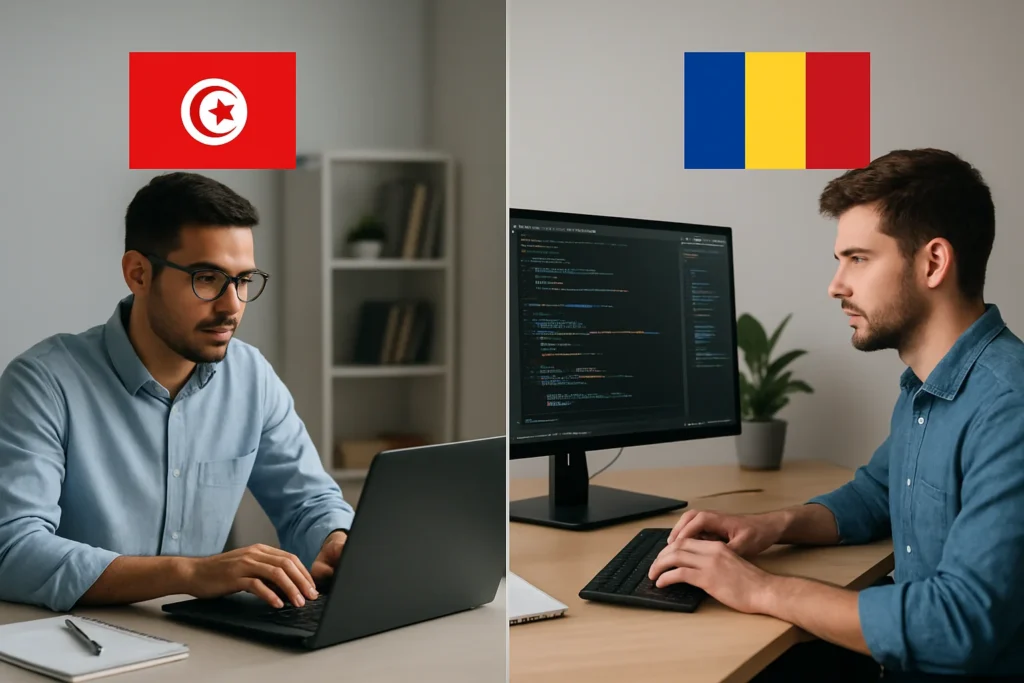
Quick answer: which country is more competitive?
For many European companies, Tunisia is often the more competitive choice when the goal is to balance cost, technical quality, and long-term delivery capacity. Morocco remains a strong market, especially for larger ecosystems and certain enterprise profiles, but the real answer depends on what you are buying: a lower day rate, a faster team ramp-up, or a partner that can stay aligned with your product roadmap.
The real problem is not only finding the cheapest developer. It is finding a team that can deliver reliably without creating hidden costs in management, rework, communication, or technical debt. A cheap developer can become very expensive when every feature needs three meetings, two fixes, and one small emotional breakdown.
In short: Tunisia is often highly competitive for nearshore software development when you want strong value, bilingual communication, GMT+1 alignment, and fast onboarding. Morocco can also be attractive, but the best option depends on seniority needs, delivery model, and the level of control you want to keep on your side.
Table of contents
- What does developer day rate really include?
- Tunisia vs Morocco: what changes in practice?
- How do cost and total delivery cost compare?
- Why this choice matters for your business
- How to choose the right country for your project
- What mistakes should you avoid?
- FAQ
- Need support?
What does developer day rate really include?
A developer day rate is not just the price of one person for one day. It reflects seniority, stack expertise, communication ability, delivery reliability, and the level of support around that developer. If you compare only the number on the quote, you are comparing the visible part of the iceberg and ignoring the part that usually hits the budget.
For decision-makers, the useful question is not “Which country is cheaper?” but “Which country gives me the best delivery output for the total cost?” That total cost includes recruitment, onboarding, coordination, quality control, maintenance, and the time your internal team spends managing the external team.
This is why serious buyers look at developer day rate in Tunisia and Morocco through a business lens, not a purely accounting lens. The objective is simple: deliver faster without losing control.
Tunisia vs Morocco: what changes in practice?
Tunisia and Morocco both offer access to qualified francophone and international talent. Both can support software outsourcing, staff augmentation, and dedicated teams. But the operating context is not identical.
Tunisia: why many European companies find it highly competitive
Tunisia is often chosen for its strong engineering culture, French and English communication, and close timezone alignment with Europe. For companies that need business application development Tunisia, SaaS delivery, or team extension, this can reduce friction from day one.
Another practical advantage is the combination of cost efficiency and collaboration speed. When a product owner, CTO, and external team can work in the same business hours, decisions move faster. That matters more than people admit in budget meetings.
Tunisia is also attractive for companies looking at automation development Tunisia operations, cloud projects, legacy modernization, and long-term maintenance. These projects need more than coding capacity. They need consistency, documentation, and technical ownership.
Morocco: where it can be strong
Morocco is also a serious nearshore market, especially for companies already familiar with its ecosystem or looking for larger delivery structures. It can be a strong option for certain enterprise environments, multilingual teams, and projects that benefit from a broad talent base.
In practice, Morocco may be particularly relevant when the company values scale, existing vendor relationships, or specific domain experience. The right choice depends less on geography and more on the quality of the team you can actually secure.
How do cost and total delivery cost compare?
Day rate comparisons are useful only if they are connected to delivery output. A lower rate does not automatically mean lower cost. If a team needs heavy supervision, lacks documentation, or produces unstable code, the real cost rises quickly.
| Factor | Tunisia | Morocco | Business impact |
|---|---|---|---|
| Day rate | Often highly competitive | Competitive, varies by profile | Impacts budget, but not the full cost |
| Timezone alignment | GMT+1, very close to Europe | Also close to Europe | Affects meeting rhythm and delivery speed |
| Language fit | Strong FR/EN availability | Strong FR/EN availability | Reduces communication overhead |
| Talent profile | Strong full-stack, SaaS, cloud, data | Strong across many domains | Determines how much guidance is needed |
| Delivery model fit | Very strong for nearshore teams | Very strong for nearshore teams | Depends on governance and team structure |
If your project is a SaaS product, a fintech backend, or a platform with integration complexity, the cheapest rate is rarely the best metric. The better question is whether the team can protect your roadmap, reduce technical debt, and stay productive after the first three months.
That is why many companies compare not only rates but also developpeur tunisie tarifs moyens, team seniority, and the cost of management. A senior developer with good autonomy can outperform two cheaper profiles who need constant direction. Fewer meetings, fewer surprises, better sleep. That is a valid business KPI too.
Why does this choice matter for your business?
The country you choose affects more than payroll. It influences time-to-market, product quality, recruitment pressure, and your ability to scale without internal bottlenecks.
For a SaaS company accelerating its roadmap, the difference between a reactive vendor and a dedicated team can mean several weeks saved per release cycle. For a CTO struggling to recruit locally, nearshore development can unlock delivery capacity without waiting months for the right hire. For an operations manager, it can reduce dependency on one internal developer who currently knows too much and documents too little.
In other words, the decision is commercial. It affects how quickly you can launch, how safely you can scale, and how much control you keep over the product.
Projects such as commerce platform development Tunisia or nearshore software development commerce are good examples. They require both speed and discipline: checkout logic, integrations, security, and maintenance cannot be handled like a weekend side project.
How should you choose between Tunisia and Morocco?
Use this simple decision framework.
Choose based on delivery needs, not just price
- If you need fast onboarding and close collaboration with European hours, Tunisia is often a very strong option.
- If you need a broader vendor ecosystem or already have local experience in Morocco, that may be the better fit.
- If your project is complex, prioritize seniority, communication, and governance over the lowest day rate.
Check these points before you decide
- Can the team work in your timezone and reporting rhythm?
- Do they have experience with your stack, product type, and integration needs?
- Who owns documentation, testing, and code quality?
- How quickly can they onboard and start producing value?
- What happens if the initial developer leaves or the scope changes?
For companies comparing engineering team Tunisia analytics or infrastructure-heavy projects, the best partner is usually the one that can explain architecture decisions clearly, not the one that only talks about price. The same logic applies to infrastructure practical european companies: reliability beats promotional promises every time.
What mistakes should you avoid when comparing day rates?
The most common mistake is comparing countries instead of delivery models. A freelancer, a staff augmentation setup, and a dedicated team are not the same thing. They solve different problems.
Another mistake is ignoring hidden costs. Poor documentation does not hurt on day one. It hurts six months later, when everyone looks at the codebase like it was written by a mysterious civilization.
Also avoid choosing a provider that cannot explain governance. Outsourcing without governance is not a delivery model. It is hope with a contract attached.
Finally, do not underestimate knowledge transfer. If the external team does not document decisions, tests, and architecture, your internal team inherits the risk later. That risk shows up as slower delivery, higher maintenance cost, and reduced flexibility when the product needs to evolve.
FAQ
Is Tunisia always cheaper than Morocco for developers?
Not always. Rates vary by seniority, stack, and delivery model. Tunisia is often very competitive, but the real comparison should include communication, onboarding speed, and total delivery cost.
Which country is better for a dedicated software team?
Both can work well. Tunisia is often preferred for strong nearshore alignment with Europe, especially when fast collaboration and bilingual communication matter. The best choice depends on the team you can secure.
Is a lower day rate enough to justify outsourcing?
No. A lower rate only helps if the team delivers quality work with limited supervision. If management overhead rises, the savings can disappear quickly.
What type of projects fit Tunisia well?
Tunisia is a strong fit for SaaS products, web platforms, mobile apps, maintenance, and team extension. It is also well suited for companies that want stable nearshore collaboration with Europe.
How do I reduce outsourcing risk?
Define scope, ownership, documentation, reporting, and quality standards from the start. A good partner should make delivery predictable, not just affordable.
What is the practical conclusion for decision-makers?
If your priority is to reduce cost without losing control, Tunisia is often one of the most competitive nearshore options for European companies. Morocco remains a credible alternative, but the best choice depends on the kind of team you need, the product you are building, and how much governance you want around delivery.
At LSK Soft, the objective is not simply to provide developers. The goal is to help European companies build reliable software delivery capacity through clear communication, strong technical execution and teams that integrate smoothly with their business priorities.
Whether you need software outsourcing from Tunisia, a dedicated team, or a way to extend your development team without slowing your roadmap, the right model should protect your budget and improve execution at the same time.
Need to extend your development team without slowing your roadmap? LSK Soft can help you build a dedicated nearshore software team aligned with your technical needs, delivery rhythm and business goals.