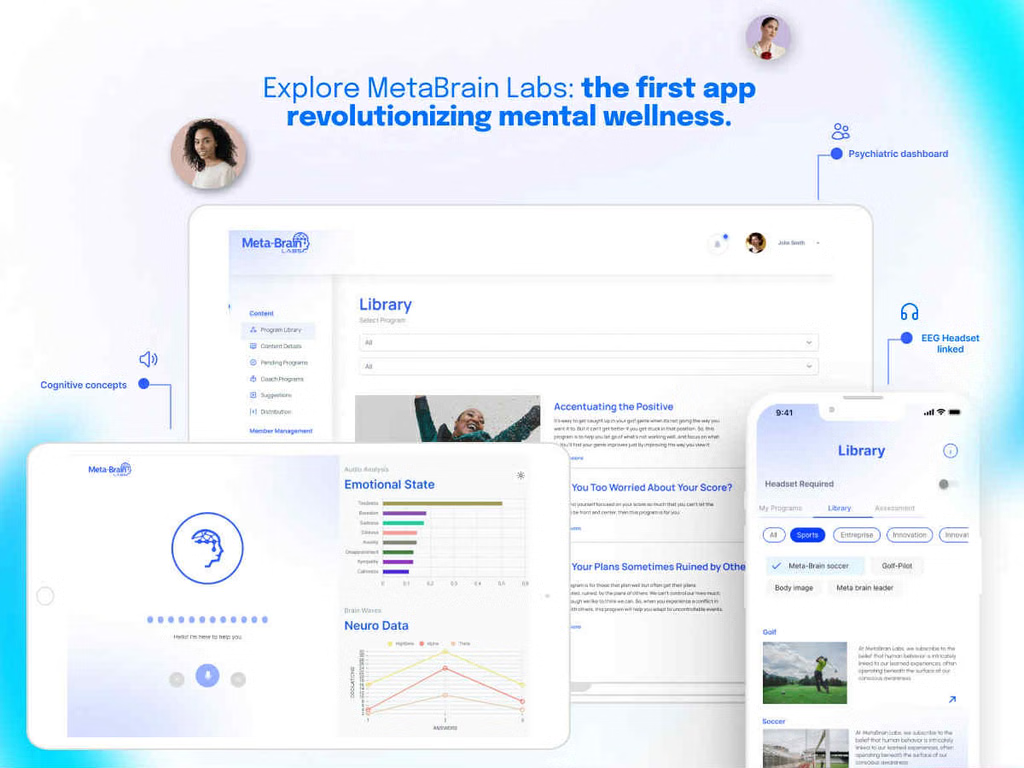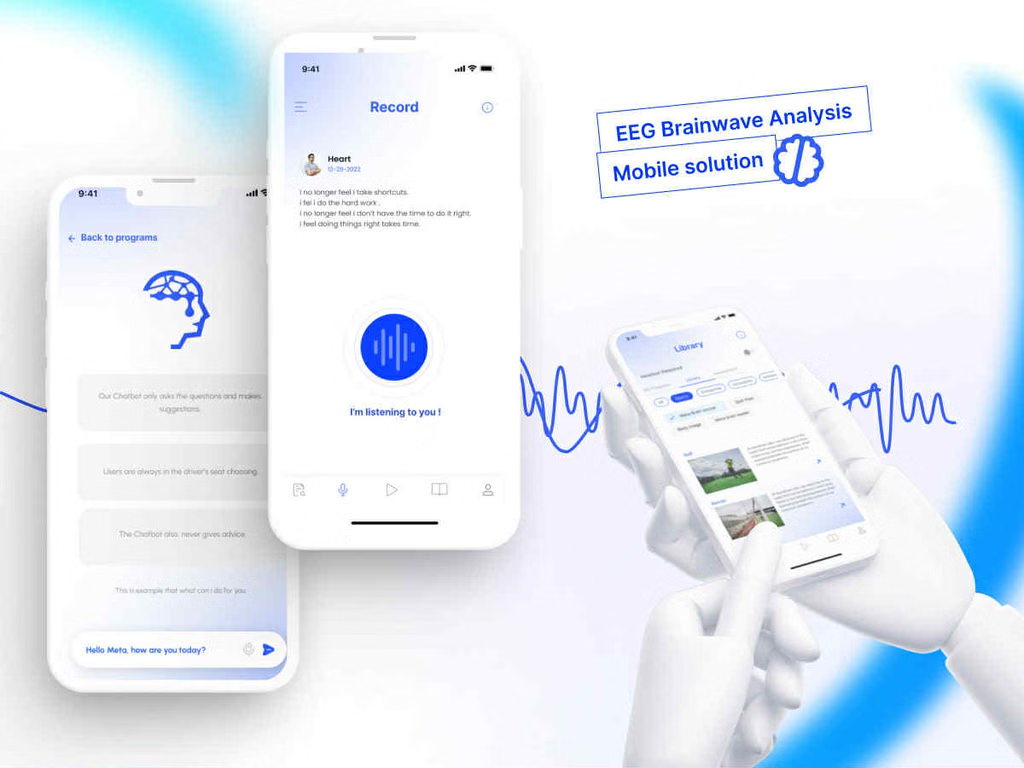
A US-based NeuroTech company pioneering sensor-integrated AI agents needed a complete digital platform to bring their mental wellness vision to life — combining real-time biofeedback, conversational AI, and adaptive therapeutic programmes into a single, clinically responsible product. We delivered the full platform through an outsourced engineering team, with HIPAA compliance embedded as a foundational requirement from day one.
Context & Challenge
The client had developed a clinically grounded approach to mental wellness: rather than relying on static content or generic chatbot interactions, their model uses real-time biometric and neurobiological data to understand what a user is actually experiencing — and adapts the therapeutic experience accordingly.
The challenge was turning that vision into a deployable product. Existing mental wellness applications treat AI as a content engine. This platform needed AI to function as a responsive, sensor-aware system — one that interprets live signals, detects cognitive and emotional states, and delivers personalised interventions in the moment.
Building that required a robust backend capable of processing real-time biometric streams, a mobile application with native sensor integration, a web platform for programme management and clinical oversight, an AI layer grounded in the client’s proprietary therapeutic knowledge base, and a cloud infrastructure that could handle sensitive health data at scale — all in full compliance with HIPAA regulations.
Our Approach
We took end-to-end ownership of the platform engineering, providing a fully dedicated outsourced team across backend, mobile, web, AI, and cloud infrastructure.
The architecture was designed around four core requirements: real-time data responsiveness, adaptive AI personalisation grounded in proprietary clinical content, event-driven scalability, and healthcare-grade security. Every layer of the stack was built with HIPAA compliance as a non-negotiable constraint, not a post-launch consideration.
The AI layer was designed to go beyond conversational response. By combining Retrieval-Augmented Generation with live biometric signal integration, the platform delivers therapeutic interactions that are simultaneously grounded in the client’s clinical methodology and dynamically responsive to each user’s physiological state in real time.
Technology & Architecture
The platform was built on a modern, cloud-native, event-driven stack optimised for real-time performance, cross-platform delivery, and regulated healthcare environments:
- Spring Boot for the backend API and core business logic — handling real-time biometric data ingestion, AI agent orchestration, user session management, programme delivery, and service coordination.
- React Native for the cross-platform mobile application on iOS and Android, with native device integration for wearable connectivity, biometric data collection, and real-time push interactions.
- Next.js (React) for the web platform, serving clinician dashboards, programme administration, and the browser-based user experience with server-side rendering for performance and SEO.
- Azure for the full cloud infrastructure — scalable compute, managed databases, secure data storage, real-time messaging, and AI model execution.
- Azure AI for large language model execution, embedding generation, and AI agent orchestration within the Azure ecosystem.
- RAG (Retrieval-Augmented Generation) to ground every AI response in the client’s proprietary therapeutic content, clinical methodology, and user history — ensuring outputs are accurate, on-protocol, and contextually relevant rather than generically generated.
- Apache Kafka for high-throughput, real-time event streaming across the biometric data pipeline — ensuring low-latency delivery of sensor signals from device to AI processing layer.
- gRPC for high-performance, low-overhead communication between internal microservices.
- Redis for caching, session state management, and real-time data availability across the platform.
- Elasticsearch for semantic search across the therapeutic content library, user history, and programme assets — powering the RAG retrieval layer.
- Azure Cosmos DB for flexible, globally distributed storage of user profiles, biometric records, and session data.
- Microsoft SQL Server for structured relational data — programme definitions, clinical configurations, and audit records.
- Full HIPAA Compliance across all layers — encryption at rest and in transit, role-based access control, audit logging, secure API authentication, and infrastructure configuration aligned with HIPAA Technical Safeguard requirements.
Key Features Built
- Real-Time Biometric Signal Processing — The backend ingests continuous biometric data streams from wearable and clinical-grade sensors via a Kafka event pipeline, processes them in real time, and feeds them into the AI agent layer — enabling the platform to respond to what the user is actually experiencing, not just what they report.
- RAG-Powered Adaptive AI Therapeutic Agent — A conversational AI agent combining Retrieval-Augmented Generation with live biometric signal integration. The RAG layer retrieves relevant therapeutic content, user history, and clinical protocols from the Elasticsearch-backed knowledge base, ensuring every response is grounded in the client’s methodology. The biometric layer adds real-time physiological context, enabling the agent to detect stress, dissonance, or emotional conflict and adapt its guidance accordingly.
- Personalised Mental Wellness Programmes — Dynamic programme delivery that adjusts content, pacing, and intervention type based on each user’s neurobiological profile, session history, and real-time physiological state — moving beyond generic wellness content toward genuinely individualised care.
- HIPAA-Compliant Mobile Application — A React Native application with deep native integration for wearable device connectivity, real-time biometric capture, and secure health data handling — designed to meet healthcare regulatory requirements on both iOS and Android.
- Clinician & Programme Management Web Platform — A Next.js web platform enabling programme administrators and clinical oversight teams to manage user journeys, monitor outcomes, configure therapeutic content, and access compliance-ready reporting.
- Event-Driven Data Pipeline — A Kafka-based streaming architecture that handles continuous biometric data ingestion at scale, decouples the sensor collection layer from the AI processing layer, and ensures reliable, ordered delivery of health data events across the platform.
- Secure Health Data Infrastructure on Azure — A fully managed Azure cloud environment handling sensitive health data with end-to-end encryption, access-controlled storage across Cosmos DB and SQL Server, audit-ready logging, and scalable compute — designed for growth from early users to clinical-scale deployment.
Compliance & Security
HIPAA compliance was architected into the platform from the ground up:
- End-to-end encryption for all patient and biometric data in transit and at rest
- Role-based access control across mobile, web, and backend layers
- Full audit logging for all data access, modifications, and system events
- Secure service-to-service authentication via gRPC across the microservices layer
- Azure infrastructure configuration aligned with HIPAA Technical Safeguard requirements
- Data handling practices designed to support Business Associate Agreement obligations
- Elasticsearch index-level access controls protecting the RAG retrieval layer
Impact
The platform enables a category of mental wellness application that has not previously been deployable at scale: one where AI responses are simultaneously grounded in proprietary clinical content via RAG and informed by what the user’s body is signalling in real time.
The result is a therapeutic experience that is more responsive, more personalised, and more clinically credible than anything a conventional large language model or static wellness application can deliver.
By delivering the full technical platform — mobile, web, backend, AI pipeline, and cloud — through a single outsourced engineering team, the client was able to move from product vision to a production-ready system without building an internal engineering organisation.
Delivery Model
This project was delivered through full IT team outsourcing — we provided the complete engineering team covering backend, mobile, web, AI and RAG integration, data engineering, and Azure cloud architecture. The client retained product vision and clinical direction while we owned technical execution end-to-end, from architecture design through to production deployment.
Expertise Demonstrated
- HIPAA-compliant digital health platform development
- RAG implementation and AI agent integration on Azure
- Real-time biometric data processing with Kafka event streaming
- React Native mobile development with wearable device integration
- Next.js web platform development
- Spring Boot microservices architecture with gRPC
- Elasticsearch-powered semantic search and retrieval
- Azure cloud infrastructure for regulated healthcare environments
- HealthTech IT team outsourcing
- End-to-end product delivery for clinically sensitive applications
Vision
This project represents the direction mental wellness technology is moving: away from static content delivery and toward intelligent, sensor-aware systems that understand users in real time and respond with clinically grounded, personalised guidance.
By combining RAG-powered AI, real-time biometric data, an event-driven architecture, and a compliance-first infrastructure, the client is positioned to offer a level of personalisation and clinical credibility that generic wellness applications cannot match.
The engineering foundation we delivered is built to scale — from early adopters through to clinical deployment and beyond.